
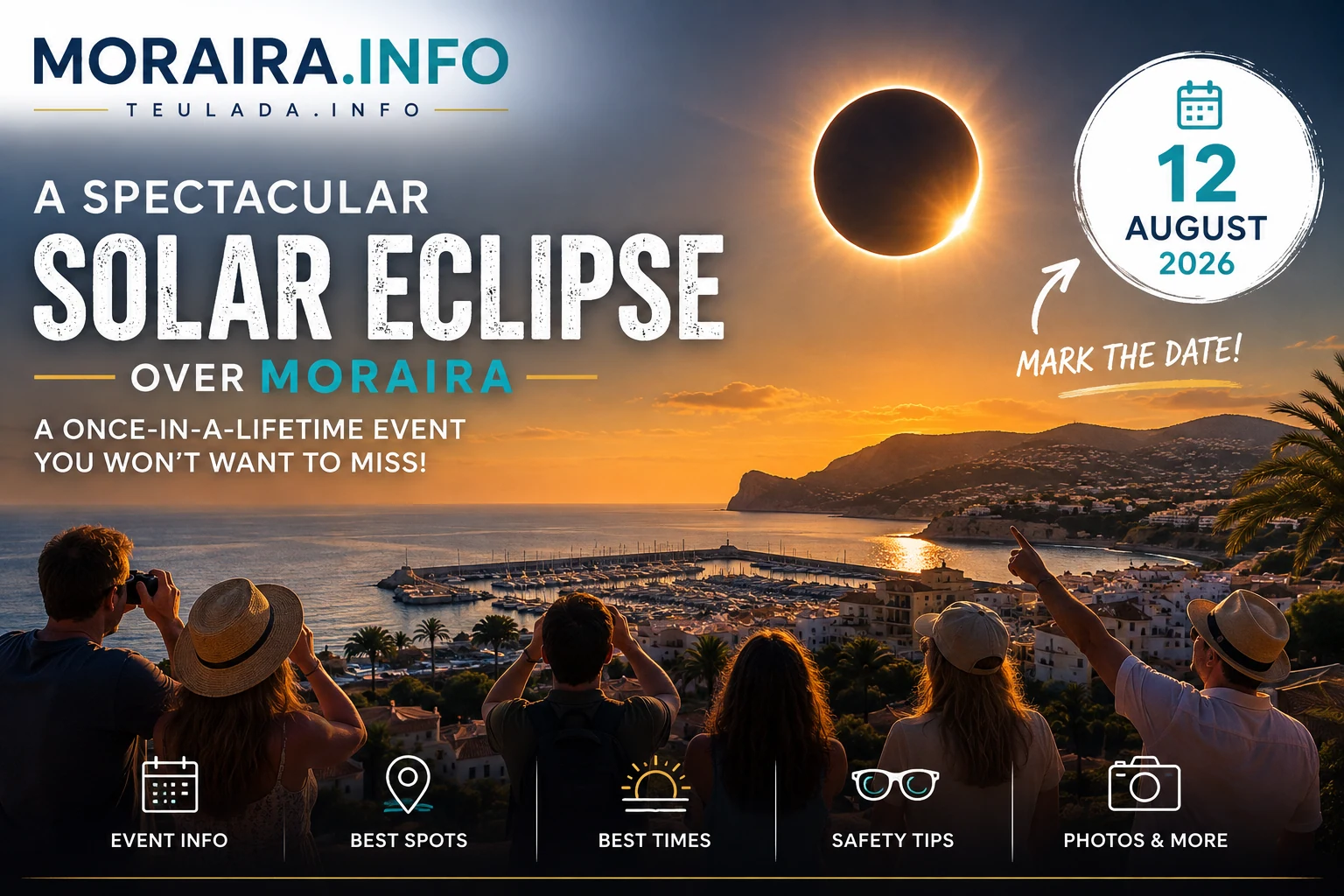
On Wednesday, 12 August 2026, the sky above Moraira will be well worth watching. Shortly before sunset, the Moon will cover almost the entire Sun. Moraira and Teulada sit immediately south of the path where the eclipse becomes total, and at maximum the Sun will be only a few degrees above the horizon.
Spain’s Instituto Geográfico Nacional (IGN) gives Teulada an eclipse magnitude rounded to 1.00, but lists no start or end time for totality. We therefore describe the event in Teulada-Moraira as a near-total partial solar eclipse, not a total eclipse.
Official times for Teulada-Moraira
- 19:39:40 – Eclipse begins: The Moon starts moving across the Sun.
- 20:34:00 – Maximum: The Sun is extremely strongly covered and stands only about 4° above the horizon.
- 20:58:00 – Sunset: The Sun drops below the horizon around 24 minutes after maximum.
These are the IGN municipal values for Teulada in official Spanish summer time. Seconds and the practical moment when the Sun disappears may vary slightly across the municipality. Hills, buildings or trees can end the view earlier than the astronomical sunset.
Our advice: be in position by 19:30
Arriving only for maximum means missing most of the transformation. Watching the Sun gradually narrow to a slim crescent, together with the changing light across the landscape, is a major part of the experience.
Look west-north-west
At maximum, the IGN gives the Sun an azimuth of approximately 286°. You therefore need a clear view towards the west-north-west. A beautiful sea view is not enough: with the Sun only four degrees high, even a modest hill or building can block the crucial line of sight.
1. Higher ground around Benimeit
Elevated, publicly accessible places above Moraira may offer a wide outlook. The essential check is whether the horizon around 286° is genuinely open. Photographers may find attractive combinations of landscape, low Sun and observers in silhouette.
2. Open locations between Moraira and Teulada
Good conditions may also be found slightly inland. Proximity to the sea is not the main criterion; height and a low west-north-western horizon matter more.
3. West-facing terraces
An elevated terrace or roof terrace with an unobstructed western view may already be an excellent location. The simplest test is to check from the intended spot at around 20:30 on the previous evening and see whether the Sun is still visible.
4. Other open viewpoints
Use a smartphone compass, set it to roughly 286° and look for hills, trees or buildings in that direction. Use only public or legally accessible areas, keep roads and entrances clear, and respect private property.
What about El Portet, Cap d’Or, the beach or harbour?
They are beautiful places, but they are not automatically the best choice for this eclipse. The Sun will not be high over the open sea; it will be extremely low in the west-north-west. Terrain can block it from some positions. The key rule is: choose the best horizon, not simply the prettiest viewpoint.
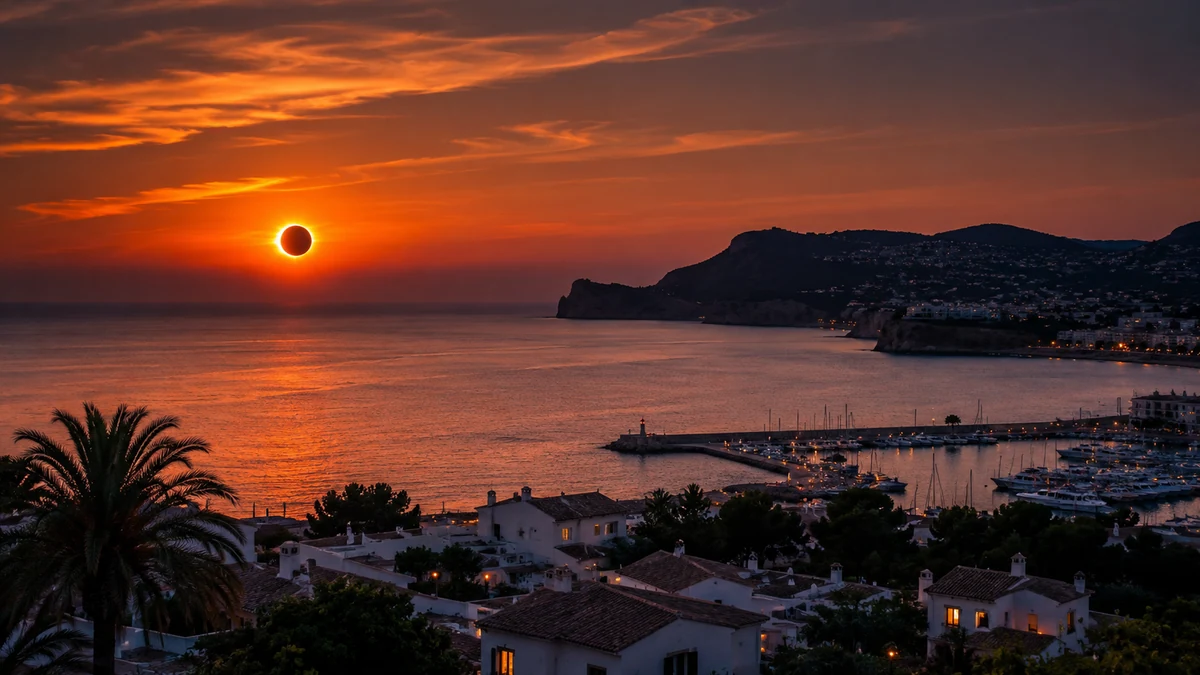
What is the weather outlook?
Updated 10 August 2026: The current AEMET forecast for Teulada shows partly cloudy conditions for Wednesday and a 0 per cent chance of precipitation. Its current table displays no active Wednesday warning for the “Litoral norte de Alicante” warning zone.
A forecast can change over two days, and low cloud close to the horizon could be decisive. Check AEMET again on Wednesday and inspect the actual west-north-western horizon before setting out.
Essential eye safety
An almost completely covered Sun is not safe to view without protection. Because the IGN lists no total phase for Teulada, use proper protection throughout the entire event:
Never look directly at the Sun without suitable eye protection.
- Ordinary sunglasses are not sufficient.
- Eclipse glasses or handheld solar viewers must be designed for direct solar viewing and comply with ISO 12312-2.
- Do not use scratched, torn or damaged filters.
- Children must be supervised.
Full guidance is available from NASA Eclipse Safety and the IGN.
Binoculars, telescopes and cameras
Never point unfiltered binoculars, a telescope or a camera lens at the Sun. Wearing eclipse glasses does not make an unfiltered optical device safe. A suitable solar filter must be securely fitted to the Sun-facing front of the optics. Seek specialist advice if unsure.
Photography and video
Using a smartphone
The landscape often tells a stronger story than extreme digital zoom. Sea, hills, buildings, people and changing light show where the event happened. Keep the phone steady, avoid digital zoom and reduce exposure on the bright sky. Direct images of the Sun also require a suitable solar filter over the phone camera.
Using a mirrorless or DSLR camera
A telephoto lens can show the crescent in more detail, but it needs a proper solar filter on the front throughout the eclipse. An unfiltered telephoto lens can damage both eyes and equipment. A tripod and remote release help prevent camera shake.
Try a time-lapse
Set up a phone or camera on a stable tripod before 19:39 and keep a fixed composition until sunset. More than an hour of sky movement and changing light can then be condensed into a few seconds. A solar filter remains essential whenever the camera points directly at the Sun.
Wednesday evening checklist
- ISO 12312-2 eclipse glasses
- Clear west-north-western horizon
- Smartphone compass set to about 286°
- Be ready by approximately 19:30
- Charged phone, camera and power bank
- Tripod and correct front-mounted lens filter
- Water, and no blocking of roads or entrances
- Final weather check on Wednesday
An exceptional summer evening
August on the Costa Blanca, the Sun only a few degrees above the horizon and an almost complete covering: anyone in Moraira on Wednesday should mark the evening. It may also be worth putting the camera away for a few minutes. Some moments deserve to be experienced as well as recorded.
At a glance: start 19:39:40, maximum 20:34:00, sunset 20:58:00. Use proper eclipse glasses and find an unobstructed west-north-western horizon.
Sources: Instituto Geográfico Nacional / Observatorio Astronómico Nacional, AEMET and NASA. Local astronomical values refer to the IGN municipality table for Teulada.